Order Blocks: The Complete ICT and SMC Guide – Part 1
In the first part of the Order Blocks series, you will learn about the structure of bullish and bearish order block zones, Premium and Discount ranges, and the role of the Mean Threshold in analysing price behaviour.
Part of “ICT & SMC A-Z Guide”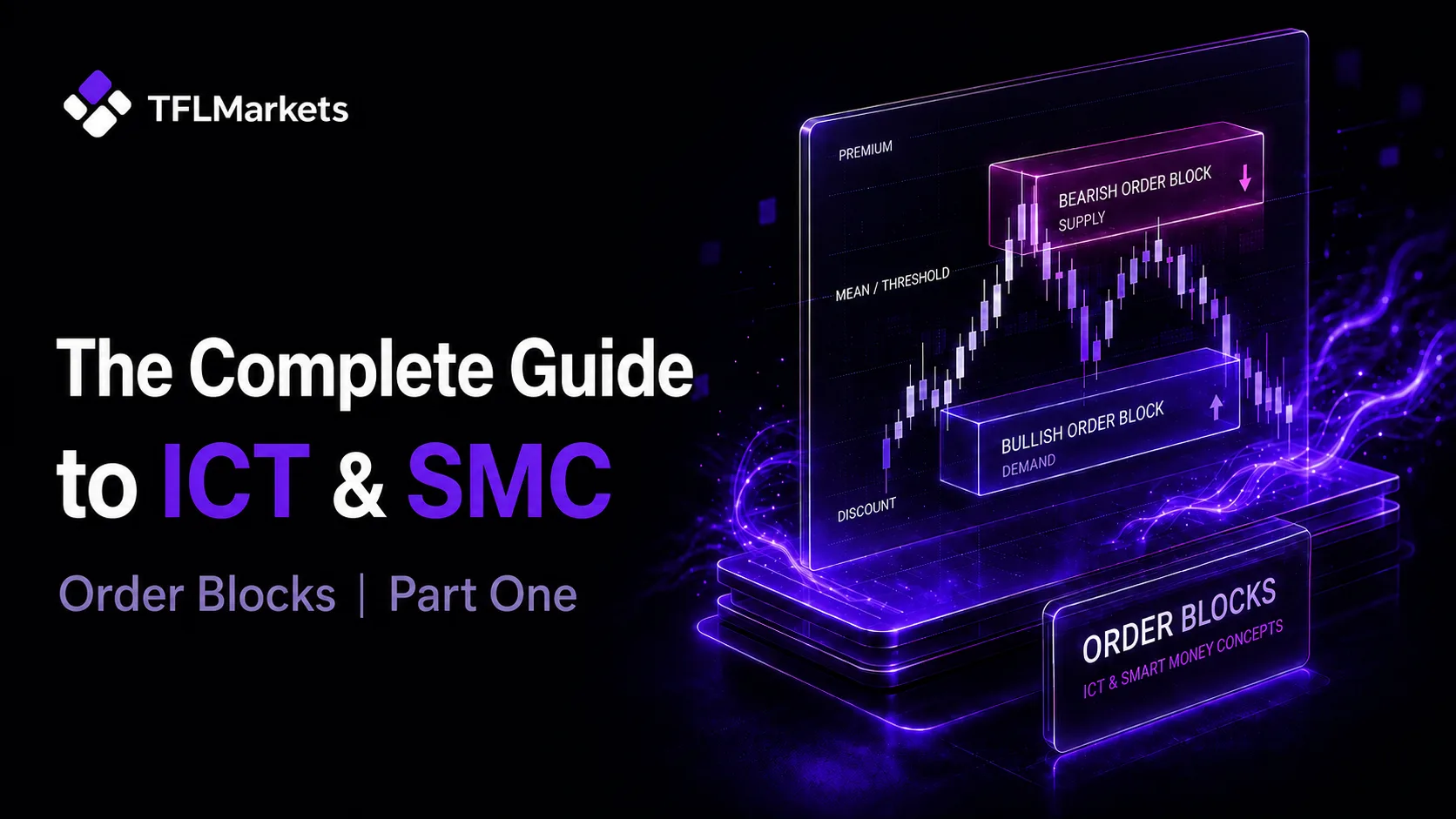
What Is an Order Block?
In financial markets, large traders and institutions are not always able to execute their entire position at a single price. A large order can move the market quickly, changing the conditions under which they originally intended to enter.
According to the Order Block concept, certain areas on a chart may represent zones where large buy or sell orders entered the market. If some of those orders remain unfilled, price may react when it returns to the same area in the future.
However, identifying an order block requires more than simply finding a candle that moves against the direction of the following price movement. Several additional factors should be considered:
The candle’s position within the market structure
The zone’s proximity to support or resistance
The strength of the move that followed
Whether a previous market structure or price level was broken
How price reacts when it returns to the zone
For this reason, an order block should be analysed as part of the broader market structure rather than treated as a standalone entry signal.
Types of Order Blocks
Order blocks are generally divided into two main categories:
Bullish Order Block
Bearish Order Block
The difference between these two types lies in the expected direction of price and the structure that forms before the main market move begins.
What Is a Bullish Order Block?
A Bullish Order Block is an area that may form before a strong upward price movement. It usually consists of a bearish candle or a sequence of bearish candles located near a support area.
After these candles form, price moves higher and may break a previous high or market structure. In this situation, the area from which the bullish move began can be examined as a potential Bullish Order Block.
The following conditions can be used as an initial framework for identifying a bullish order block:
Price is trading near a support area.
The zone is located within the Discount portion of the dealing range.
One or more bearish candles form inside the area.
Price moves upward with clear strength after leaving the zone.
A previous high or market structure is broken.
Price shows a bullish reaction when it returns to the area.
The bullish move following the bearish candle is especially important. Without a strong reaction or a clear change in market structure, a candle should not be classified as a bullish order block simply because it is bearish.
What Is a Bearish Order Block?
A Bearish Order Block is an area that may form before a strong downward price movement. It usually consists of a bullish candle or a sequence of bullish candles located near a resistance area.
After these candles form, price moves lower and may break a previous low or market structure. The area from which the bearish move began can then be examined as a potential Bearish Order Block.
The following factors can be considered when identifying a bearish order block:
Price is trading near a resistance area.
The zone is located within the Premium portion of the dealing range.
One or more bullish candles form inside the area.
Price falls with clear strength after leaving the zone.
A previous low or market structure is broken.
Price shows a bearish reaction when it returns to the area.
Once again, not every bullish candle is automatically a bearish order block. The candle’s location, the strength of the following move, and the resulting change in market structure should all be analysed together.
The Relationship Between Order Blocks and Support and Resistance
One of the most important considerations when identifying an Order Block is its relationship with support and resistance.
A bullish order block may carry greater significance when it forms within a meaningful support area. Similarly, a bearish order block may be more relevant when it appears near an established resistance zone.
Support and resistance do not always behave as exact horizontal lines. In many cases, they are broader price areas in which the market can react at different levels.
Order blocks should therefore also be treated as zones rather than fixed, precise prices.
For example, searching for a Bullish Order Block near support while the market is showing bullish characteristics is more logical than randomly selecting every bearish candle on the chart.
What Role Do Premium and Discount Play?
In ICT and Smart Money Concepts, a dealing range can be divided into two sections: Premium and Discount.
The upper half of the range is called Premium.
The lower half of the range is called Discount.
Conceptually, traders look for more favourable buying opportunities in the Discount portion of a range and more favourable selling opportunities in the Premium portion.
A Bullish Order Block may therefore be more appropriately positioned when it forms in Discount. A Bearish Order Block may be better aligned with a potential selling opportunity when it forms in Premium.
However, the location of an order block within Premium or Discount does not confirm its validity on its own. Market structure, support and resistance, the strength of the price move, and the reaction on the return to the zone must also be considered.
What Is the Mean Threshold of an Order Block?
The Mean Threshold refers to the 50% level of a candle’s body or the selected order block range.
This level can be used to assess how deeply price has moved into an Order Block. When price returns to the zone, its behaviour around the 50% level may provide additional information about the strength or weakness of the area.
A reaction before price penetrates deeply beyond the Mean Threshold may suggest that the zone is still holding its strength. In contrast, a clear move through this level and deeper into the order block may indicate that the zone is losing effectiveness.
The Mean Threshold should not be used as an independent entry signal. It is only one part of the order block analysis process and should be considered alongside market structure, liquidity, directional bias, and price reaction.
Is an Order Block Always a Single Candle?
No. One common mistake is assuming that an Order Block must always consist of only one candle.
In some situations, several consecutive candles may form a single order block. For example, a sequence of bearish candles may appear immediately before a strong bullish move. In that case, the entire group of candles may be treated as one area for analysis.
Focusing too heavily on selecting one specific candle can cause traders to overlook the broader structure of the move. The main objective is to identify the area from which the significant price expansion began, rather than forcing every setup into a single-candle model.
Characteristics of a Valid Order Block
Several factors can be considered when assessing the quality and validity of an Order Block.
Strong Price Displacement
Price should make a clear and meaningful move after leaving the zone. Weak or irregular movement generally provides less evidence that the area is significant.
A Break in Market Structure
If the move originating from the order block breaks an important high or low, the zone may have greater analytical value.
Appropriate Chart Location
An order block should form in a meaningful location, such as support, resistance, Premium, or Discount.
Limited Retests
A zone that has already been tested several times may have lost some of its original strength because part of the available orders may already have been filled.
A Clear Price Reaction
The way price behaves when it returns to the zone is important. Strong rejection candles, decisive price movement, or a lower-time-frame shift in structure may provide additional information.
Order Blocks vs. Supply and Demand Zones
Order blocks and supply and demand zones share certain similarities, but they are not exactly the same.
Both concepts are used to identify areas where price may react. However, order block analysis places greater emphasis on candle structure, the subsequent price movement, market structure breaks, and the position of the zone within the ICT and Smart Money Concepts framework.
In general:
A Bullish Order Block may resemble a demand zone.
A Bearish Order Block may resemble a supply zone.
The validity of an order block is often assessed through market structure and the move that follows the zone.
Not every supply or demand zone qualifies as a valid order block.
Common Mistakes When Identifying Order Blocks
Treating Every Opposing Candle as an Order Block
A bearish candle before an upward move or a bullish candle before a downward move is not enough to confirm an Order Block.
The result of the following price movement must also be examined, including whether an important market structure was broken.
Ignoring the Location of the Zone
An order block identified without considering support, resistance, Premium, Discount, and market structure may have limited analytical value.
Expecting a Guaranteed Reaction
No order block can guarantee a successful trade. Markets operate on probabilities, and even well-positioned zones can fail.
Entering Without Confirmation
Entering a trade solely because price has reached an Order Block can involve significant risk. Price behaviour and the broader market context should be assessed before making a decision.
Ignoring Risk Management
Even when an order block appears valid, the analysis can still fail. Position sizing and stop-loss placement are therefore essential parts of any trading strategy.
Marking an Overly Wide Zone
An order block that is too wide may create an unfavourable risk-to-reward ratio. The zone should be defined according to the actual candle structure and the price movement that followed.
How to Practise Identifying Order Blocks
The most effective way to understand order blocks is to review historical charts and mark different examples.
During practice, consider the following questions:
Did the zone form near support or resistance?
Was price located in Premium or Discount?
How strong was the move away from the zone?
Did the move break a previous market structure?
Was the order block formed by one candle or several candles?
How did price react to the Mean Threshold on its return?
Had the zone already been tested?
What differences can be observed between successful and unsuccessful examples?
Recording these examples in a trading journal can help reveal recurring patterns. Your journal can include chart screenshots, time frames, entry points, stop-loss levels, trade outcomes, and the reasons behind selecting each order block.
The purpose of this exercise is to develop a personal, data-driven understanding of the concept rather than memorising one fixed pattern and applying it to every market condition.
How to Use Order Blocks in Market Analysis
When working with Order Blocks, it is generally better to begin your analysis on a higher time frame.
Start by identifying the overall market direction and price structure. Then examine support and resistance areas and determine where price is positioned in relation to Premium and Discount. Once this context is established, you can identify order blocks that align with your directional analysis.
A simple process may look like this:
Identify the overall market direction on a higher time frame.
Define the current dealing range.
Mark the Premium and Discount portions of the range.
Identify potential Bullish or Bearish Order Blocks.
Evaluate the strength of the move away from each zone.
Check whether the move caused a break in market structure.
Wait for price to return to the zone.
Assess the price reaction and the Mean Threshold.
Set the stop-loss and position size according to your risk-management rules.
This process helps traders avoid selecting order blocks randomly and encourages them to make decisions within a structured analytical framework.
Conclusion
An Order Block is an important concept in ICT and Smart Money Concepts. It is used to identify areas where large orders may have entered the market and where price may react when it returns.
A Bullish Order Block is commonly associated with a bearish candle or a sequence of bearish candles near support and within the Discount portion of a range. A Bearish Order Block is often associated with a bullish candle or a sequence of bullish candles near resistance and within the Premium portion of a range.
The Mean Threshold represents the 50% level of an order block and can be used to evaluate price behaviour when the market returns to the zone.
The most important point is that not every candle moving against the following price direction is a valid Order Block. Market structure, the location of the zone, the strength of the move away, the resulting break in structure, and the reaction when price returns must all be analysed together.
No order block guarantees the outcome of a trade. Every trading decision should therefore be supported by proper risk management and a probability-based approach.
Frequently Asked Questions
What Is the Difference Between a Bullish and Bearish Order Block?
A Bullish Order Block forms before an upward price move and may be analysed as a potential demand area. A Bearish Order Block forms before a downward move and may represent a potential supply area.
Is Every Bearish Candle a Bullish Order Block?
No. The candle must form in a meaningful market location, and the subsequent price movement should confirm its significance.
How Is the Mean Threshold Calculated?
The Mean Threshold is generally the 50% level of a candle’s body or the complete Order Block range. The exact drawing method should remain consistent with the analytical framework being used.
Where Is the Best Location for a Bullish Order Block?
A Bullish Order Block may be more favourably positioned when it forms near support and within the Discount portion of a dealing range. However, market structure and price behaviour must still provide confirmation.
Where Is the Best Location for a Bearish Order Block?
A Bearish Order Block may carry greater significance when it forms near resistance and within the Premium portion of a dealing range. Its location alone, however, is not sufficient to justify entering a trade.
Does an Order Block Always Consist of One Candle?
No. In some situations, a sequence of consecutive candles may form a single order block.
Is Order Block Trading Error-Free?
No. An Order Block is only one tool used in market analysis, and no zone can guarantee the outcome of a trade.