Trading Killzones: The Complete Guide to ICT and SMC – Part 16
In this episode, you’ll learn how Trading Killzones work in ICT and SMC, how the Asia, London, and New York sessions interact with liquidity, FVGs, market structure, and the economic calendar, and how to use these time windows as part of a structured trading framework.
Part of “ICT & SMC A-Z Guide”What Is a Trading Killzone?
A trading killzone is a defined time window during the trading day when the probability of meaningful price movement tends to increase.
The forex market is open for most of the week, but market conditions are not equally active throughout the day. Some periods are relatively quiet and range-bound, while others are more likely to produce liquidity runs, breakouts, reversals, or strong directional moves.
Within the ICT framework, time is analyzed alongside price.
In other words, identifying an important price level is not enough. Traders should also ask:
When is price reaching that level?
A meaningful price level becomes more useful when price reaches it during a relevant market session or trading window.
This is the main purpose of killzones: combining price location with time of day.
Why Are Killzones Important in ICT and SMC?
The main purpose of a killzone is to narrow a trader's attention to periods when the market is more likely to become active.
A market being open does not mean every hour offers the same trading conditions.
Killzones can help traders:
Separate active trading periods from quieter sessions.
Study how price behaves around liquidity.
Identify periods when directional expansion may occur.
Avoid unnecessary trades during low-quality market conditions.
Better understand the daily trading profile.
A killzone does not tell you whether price will move up or down. It tells you when market behavior may deserve closer attention.
How Does the Daily Profile Relate to Killzones?
A Daily Profile (the behavioral sequence of price throughout a trading day) helps traders understand how different market sessions interact with one another.
A typical trading day may include several phases:
Consolidation
Liquidity collection
Directional expansion
Retracement
Continuation or completion of the daily move
These phases do not always appear in the same order, but analyzing them alongside market sessions can provide a clearer picture of intraday structure.
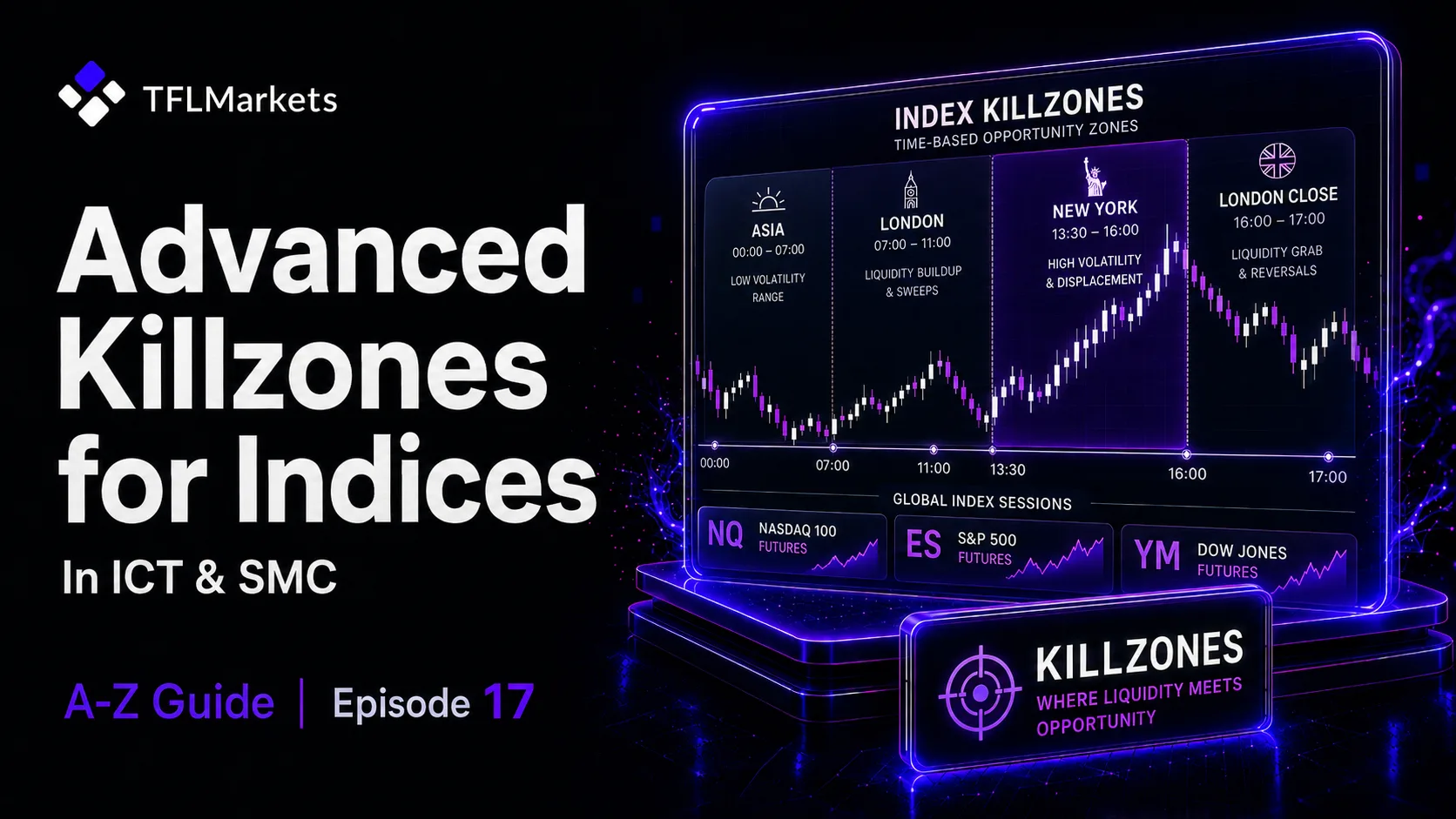
The Main Trading Sessions and Killzones
The framework discussed in this lesson focuses on four important intraday periods.
Trading Period | Approximate New York Time | Common Behavior |
|---|---|---|
Asia Session | 20:00-00:00 | Consolidation and range formation |
London Session | 02:00-05:00 | Increased volatility and possible liquidity movement |
New York Session | 07:00-10:00 | Continuation, retracement, or a new directional move |
London Close | 10:00-12:00 | Retracement, profit-taking, or movement toward liquidity |
These times should be interpreted using New York local time, especially because daylight-saving changes can affect time-zone conversions during the year.
Step 1: Establish the Higher-Timeframe Bias
Before focusing on any killzone, traders should determine the Higher Time Frame Bias (the expected directional framework based on larger market structure and higher-timeframe objectives).
For example, if higher-timeframe analysis suggests that price is likely to move toward an objective above the current market, bullish scenarios may receive more attention during a killzone.
If the main liquidity objective is lower, bearish scenarios may become more relevant.
Time alone does not provide enough information to determine market direction.
Step 2: Check the Economic Calendar
The Economic Calendar (a schedule of important macroeconomic releases, central-bank events, and other market-moving announcements) is a critical part of killzone analysis.
Events such as:
Interest-rate decisions
Inflation reports
Employment data
Central-bank speeches
can significantly increase market volatility.
On certain days, the most important move of the session may form around a major economic release rather than simply at the beginning of a killzone.
For this reason, traders should not rely on killzone timing alone.
The relationship between economic events and price structure can be more important than the killzone itself.
A practical sequence is:
Identify high-impact events scheduled for the day.
Compare their release times with the relevant market sessions.
Expect increased volatility around important announcements.
Avoid assuming direction before price confirms the scenario.
Step 3: Mark the Asia Session Range
The Asia session often creates an early intraday range.
During this period, price may trade between a relatively clear high and low, allowing liquidity to build around both sides of the range.
Liquidity (areas where orders and market positions may be concentrated) can often be found:
Above the Asia high
Below the Asia low
These areas may later become relevant during the London session.
Step 4: Observe How London Interacts With the Asia Range
The London session is one of the most important periods in forex trading.
One common scenario is for price to move through one side of the Asia range before expanding in the direction supported by the higher-timeframe bias.
For example, in a bullish scenario:
Asia forms a range.
London trades below the Asia low.
Sell-side liquidity is taken.
Price then expands higher.
However, this should never be treated as a fixed rule.
The meaning of a liquidity sweep depends on where price is located within the broader market structure.
Step 5: Look for Displacement
After liquidity has been taken, traders often look for Displacement (a strong, fast directional move that reflects a clear imbalance between buyers and sellers).
A strong move away from an important level generally provides more information than a weak or temporary reaction.
Displacement may:
Shift short-term market structure.
Create price imbalance.
Provide evidence of directional intent.
Step 6: Identify Fair Value Gaps
A rapid directional move may create a Fair Value Gap or FVG (an area of price imbalance created when price moves too quickly through a range).
In some scenarios, London produces a directional move and leaves an FVG behind. Later, during New York, price may retrace into that imbalance before continuing.
When this retracement aligns with the higher-timeframe bias, it may become an area worth monitoring.
An FVG is not automatically a trade entry. Its context, location, and timing matter.
Step 7: Understand the Role of the New York Session
The behavior of New York depends heavily on what happened during Asia and London.
New York can play several different roles.
Continuation
If London has already established a valid directional move, New York may retrace first and then continue in the same direction.
Retracement
In some cases, London may create most of the daily range, while New York simply retraces part of that move.
Reversal
If London reaches an important higher-timeframe objective, New York may create conditions for a reversal.
This means New York should not automatically be classified as either a continuation session or a reversal session.
Price structure determines the role of each session.
Step 8: Evaluate London Close
London Close occurs during the latter part of the European trading day, when many London-based participants begin closing positions or taking profits.
During this period, price may:
Retrace part of the previous move.
Move toward nearby liquidity.
Correct temporarily before continuing the broader move.
New entries during London Close should generally be evaluated carefully because a significant portion of the day's directional move may already have occurred.
How Premium and Discount Relate to Killzones
Time should not be analyzed in isolation from price location.
Premium (the relatively expensive upper portion of a trading range) and Discount (the relatively cheaper lower portion of a trading range) help traders understand where price is positioned within a larger dealing range.
For example, if the higher-timeframe framework is bearish and price is trading in a meaningful premium area, a bearish reaction during a killzone may carry more analytical significance.
The same logic can apply to bullish conditions when price is trading in discount.
Example: Using a Killzone Correctly
Assume higher-timeframe analysis suggests that EUR/USD has potential to move higher.
Before London
The Asia range is marked.
The Asia low is identified as potential liquidity.
Major economic events for the day are reviewed.
During London
Price trades below the Asia low and then quickly moves higher with strong displacement.
This move creates an FVG.
During New York
Price retraces into the FVG while maintaining the broader bullish structure.
If the rest of the trading criteria remain valid, the trader may then evaluate a continuation toward higher liquidity.
In this example:
The directional idea comes from the higher timeframe.
The possible execution area comes from price structure.
The killzone only helps identify when the scenario may become active.
Common Mistake: Treating a Killzone as an Entry Signal
One of the most common mistakes is assuming that the beginning of a killzone means a trade should immediately be taken.
That is not how killzones are intended to be used.
The start of the London Killzone does not automatically mean buy or sell.
The start of the New York Killzone does not guarantee a new directional move either.
A killzone is a time filter.
Before considering an entry, traders should evaluate:
Higher-timeframe bias
Liquidity objectives
Market structure
Price location
Economic calendar
Displacement
Fair Value Gaps or other relevant price arrays
Behavior of previous sessions
Step-by-Step Killzone Checklist
Determine the higher-timeframe directional bias.
Mark major liquidity objectives.
Review the economic calendar.
Mark the Asia session high and low.
Observe price behavior during London.
Check whether liquidity has been taken.
Look for displacement.
Identify any FVGs or relevant price imbalances.
Evaluate how New York reacts to the London move.
Consider a setup only when time, price, and structure align.
The objective is not to force a prediction. The objective is to reduce uncertainty and respond to the information price provides.
Summary
A Trading Killzone is a specific time window during which market activity and volatility may increase.
In ICT and SMC, killzones become more useful when combined with market structure, liquidity, higher-timeframe direction, and the economic calendar.
The Asia session often establishes an early range, London may interact with liquidity around that range, and New York may continue, retrace, or reverse the move depending on market context.
A killzone is a timing tool, not a standalone trade signal.
Key Takeaways
Killzones identify periods when market activity may increase.
Price structure is more important than time alone.
The economic calendar should be checked before trading.
The Asia range may create liquidity targets for later sessions.
London and New York do not behave the same way every day.
Displacement can provide evidence of directional intent.
FVGs become more meaningful when aligned with time and structure.
London Close should be analyzed in the context of the move already established earlier in the day.
Higher-timeframe bias should be established before focusing on a killzone.
Traders should react to market behavior rather than forcing a fixed session template onto price.
FAQ
What is a Trading Killzone in ICT?
A Trading Killzone is a defined period of the trading day when liquidity, volatility, and the probability of meaningful price movement may increase. It is primarily used as a timing framework.
Does a Killzone tell you when to enter a trade?
No. A killzone is not an entry signal. Market structure, liquidity, higher-timeframe bias, and other confirmation factors should also be evaluated.
Which Killzone is most important for forex?
London and New York are among the most closely watched periods, but the most relevant session depends on the currency pair, market structure, economic calendar, and overall trading context.
What is the role of the Asia session in the Daily Profile?
The Asia session often forms an early range whose high and low may later become liquidity targets during London or New York.
Does London always sweep the Asia high or low?
No. That is only one possible scenario. The meaning of any liquidity sweep depends on the broader market structure and higher-timeframe context.
Why is the economic calendar important for Killzones?
Economic releases can significantly change the timing and intensity of volatility. Killzone analysis should therefore be combined with scheduled macroeconomic events.
Does New York always continue London's move?
No. New York may continue, retrace, or reverse the London move depending on price structure and higher-timeframe objectives.
What is the best way to use Trading Killzones?
First establish higher-timeframe bias, liquidity objectives, and important economic events. Then use the relevant killzone to monitor price reaction, displacement, and structural confirmation.