Advanced Killzones for Indices: The Complete Guide to ICT and SMC – Part 17
In Episode 17 of the ICT and SMC A-Z Guide, learn how Advanced Killzones for Indices help you time NQ, ES, and YM analysis using key New York trading windows within the Daily Profile framework.
Part of “ICT & SMC A-Z Guide”What Is an Index Killzone?
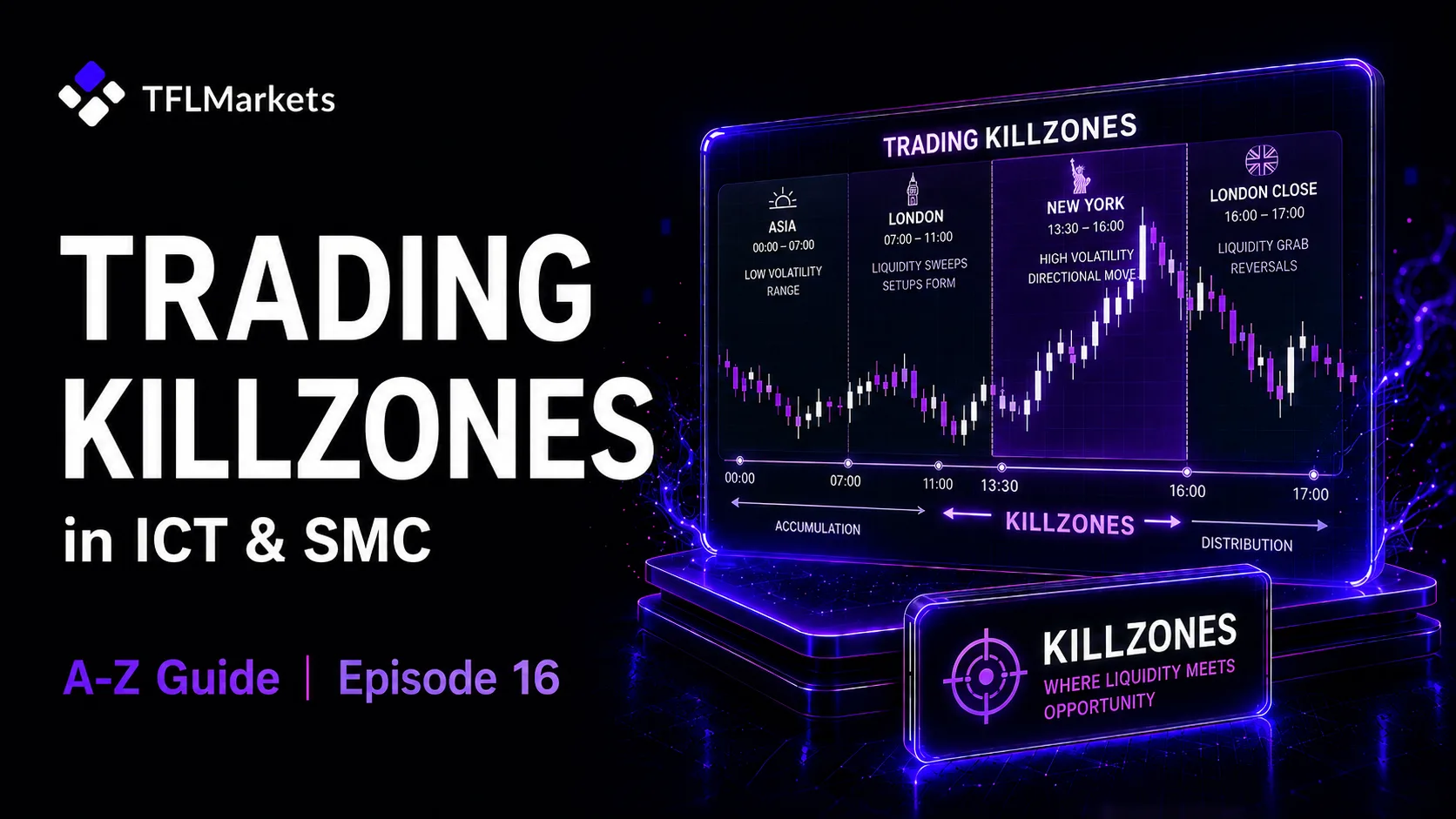
A Killzone is a defined period during the trading day when traders pay closer attention to price action because that time window may be more relevant for the market being traded.
The idea is straightforward: market behavior is not identical throughout the entire day.
Instead of searching for trades continuously from one session to another, a trader can focus on specific periods in which the selected market is more active or structurally important.
For U.S. indices, the opening of the American equity market and different phases of the New York session are particularly important.
A Killzone should therefore be understood as a time filter.
A technically valid setup appearing at an irrelevant time is not automatically a high-quality setup.
How Does the Daily Profile Relate to Killzones?
The Daily Profile describes how price movement develops and is distributed across different parts of a trading day.
It helps traders view the day as a time-based structure rather than as a random sequence of candles.
The question is therefore not only:
“Where is price?”
You should also ask:
“At what time of day did price reach this level?”
The interaction between price and time is what makes Killzones useful within a Daily Profile.
For example, a reaction at a liquidity level during a quiet period may behave very differently from a reaction at the same type of level near the U.S. market open.
Which Indices Are Used in This Model?
This framework mainly focuses on three major U.S. index futures contracts.
What Is NQ?
NQ (E-mini Nasdaq-100 Futures) is the E-mini futures contract based on the Nasdaq-100 index.
It is widely used by intraday traders and is often characterized by relatively fast and aggressive price movements compared with other major index futures.
What Is ES?
ES (E-mini S&P 500 Futures) is the E-mini futures contract based on the S&P 500.
It tracks an index representing 500 major publicly traded U.S. companies and is one of the most actively followed index futures markets.
What Is YM?
YM (E-mini Dow Jones Futures) is the E-mini futures contract based on the Dow Jones Industrial Average.
Observing NQ, ES, and YM together can provide additional context about the behavior of major U.S. equity indices during important New York trading periods.
What Are the Main Killzones for Indices?
The times below are based on New York time.
Trading Window | New York Time | Main Purpose |
|---|---|---|
New York AM Killzone | 08:30–11:00 | Main morning window for NQ, ES, and YM |
New York Cash Open | Around 09:30 | Official U.S. stock market open |
Midday Period | After AM and before PM | Usually a lower-priority period for new setups |
New York PM Killzone | 13:30–16:00 | Afternoon window leading into the cash close |
To avoid errors caused by seasonal clock changes, it is generally better to set the chart timezone directly to America/New_York.
What Is the New York AM Killzone?
The New York AM Killzone is the primary morning trading window for U.S. indices and runs from 08:30 to 11:00 New York time.
This period is especially relevant for NQ, ES, and YM because an important portion of U.S. market activity takes place during these hours.
One of the key moments inside this window is 09:30, when the U.S. cash equity market officially opens.
Traders should therefore pay particular attention to how price behaves around previously identified levels during this part of the day.
Why Is 08:30 Important?
08:30 New York time frequently overlaps with the release of important U.S. economic data and can mark the beginning of a significant increase in volatility.
However, this does not mean that a trader should automatically enter a position at 08:30.
The important point is that this time marks the beginning of a more relevant phase within the Daily Profile of U.S. indices.
An entry should be confirmed by price behavior, not simply by the clock reaching a specific time.
Why Is 09:30 Important for Indices?
09:30 New York time is the official opening time of the U.S. cash equity market.
For markets such as the Nasdaq-100, S&P 500, and Dow Jones, the cash open can bring a noticeable change in volume, liquidity, and volatility.
As a result, NQ, ES, and YM may behave very differently around 09:30 compared with several hours earlier.
This is one of the reasons index Killzones should not simply be treated the same way as Forex Killzones.
What Is the Difference Between Index and Forex Killzones?
A common mistake is applying the same Forex session timings directly to U.S. indices.
A Forex Killzone and an index Killzone do not necessarily use the same timing structure.
Market | Important New York Window |
|---|---|
Forex | Commonly around 07:00–10:00 |
Indices | 08:30–11:00 |
Indices – PM | 13:30–16:00 |
The difference reflects the stronger relationship between U.S. indices and the operating hours of the American equity market.
If you trade NQ, ES, or YM, using an index-specific time model is more appropriate than simply copying a Forex Killzone schedule.
What Is the New York PM Killzone?
The New York PM Killzone runs from 13:30 to 16:00 New York time.
It occurs after the quieter middle portion of the trading day and continues toward the U.S. cash market close.
During the PM session, price may broadly do one of two things:
continue the move established during the morning;
retrace or reverse part of the earlier move.
The actual outcome should be determined from the structure and price action of that specific trading day.
The PM Killzone does not force the market to continue or reverse.
How to Use Index Killzones Step by Step
Step 1: Choose the Market
First, define which instrument you are trading:
NQ for Nasdaq-100
ES for S&P 500
YM for Dow Jones
An index-specific Killzone model is useful only when it is applied to a market that belongs to the corresponding trading environment.
Step 2: Set Your Chart to New York Time
Set the chart timezone to New York time.
This is particularly important for traders living in other time zones.
Instead of manually converting Killzone hours throughout the year, displaying the chart directly in New York time reduces confusion caused by seasonal clock changes.
Step 3: Analyze the Daily Context Before the Killzone
Before 08:30, determine where price sits within the broader daily structure.
Questions to consider include:
Where is price relative to important highs and lows?
Where is liquidity located?
What range has the market established so far?
Is there a clear higher-timeframe directional context?
Killzones become much more useful when you already understand the market context.
Context first, timing second, entry last.
Step 4: Observe Price From 08:30 to 11:00
During the New York AM Killzone, do not enter a trade simply because the clock reaches 08:30.
Wait for the market to provide additional information.
Concepts such as a Liquidity Sweep, where price trades beyond a prior high or low and accesses liquidity, or Displacement, a strong directional price expansion, can help clarify the developing move.
A clear change in short-term market structure may also provide additional context.
Step 5: Pay Special Attention to 09:30
The U.S. cash open may reveal the structure of the morning move more clearly.
If price made a significant move before 09:30, observe how the market behaves after the official equity open.
There does not need to be a trade every day at 09:30.
The objective is to find alignment between time and price action.
Step 6: Do Not Chase Price After the AM Session
If no suitable setup appears during the morning window, entering late simply because you fear missing the move is not a sound approach.
Instead, you can wait for the next defined trading window.
This is one of the practical advantages of Killzones: the trading day is divided into specific periods, so you do not need to remain constantly engaged with the market.
Step 7: Reassess the Market From 13:30
When the New York PM Killzone begins, evaluate the Daily Profile again.
At this point, an important question is:
Is the market continuing the morning move, or is it repricing and retracing part of the earlier expansion?
The answer should come from price action rather than time alone.
Example: Using a Killzone on NQ
Suppose NQ is trading close to an important previous high before the New York session.
At 08:30, the market enters the AM Killzone.
Price initially trades above the high and accesses the liquidity resting above it. Shortly afterward, a strong bearish displacement appears and the short-term structure shifts lower.
In this scenario:
An important level had already been identified.
The move occurred during a relevant Killzone.
Liquidity was taken.
Price behavior provided evidence of a directional shift.
In this example, the Killzone itself is not the reason for entering the trade.
The Killzone tells the trader when the developing setup deserves greater attention.
Common Mistake: Treating a Killzone as a Trading Signal
One of the most common misunderstandings is assuming that a position should be opened as soon as a Killzone begins.
That is not how the concept should be used.
A Killzone is only a time filter. Other components of the trading model still need to be present.
In simple terms:
A Killzone tells you when to look, not when to click Buy or Sell.
Common Mistake: Using Forex Timing for NQ and ES
A trader coming from Forex may be accustomed to observing the New York Killzone from around 07:00.
The timing model changes when trading U.S. indices.
For NQ, ES, and YM, the primary focus shifts toward 08:30–11:00, followed by the 13:30–16:00 afternoon window.
This relatively small timing adjustment can significantly change how the Daily Profile is interpreted.
Common Mistake: Ignoring the Daily Profile
Watching a Killzone without understanding what happened earlier in the day provides incomplete context.
The market does not start from zero at 08:30.
Earlier highs, lows, ranges, and liquidity pools remain part of the current Daily Profile.
For this reason, Killzones should be analyzed inside the broader Daily Profile rather than used as isolated trading signals.
Advanced Index Killzones Summary Table
Concept | Definition |
|---|---|
Advanced Killzones for Indices | Targeted intraday trading windows for index analysis |
New York AM Killzone | 08:30–11:00 New York time |
New York Cash Open | 09:30 New York time |
New York PM Killzone | 13:30–16:00 New York time |
NQ | Nasdaq-100 futures contract |
ES | S&P 500 futures contract |
YM | Dow Jones futures contract |
Daily Profile | Distribution and development of price throughout the trading day |
Purpose of a Killzone | Time filter for identifying setups |
What a Killzone is not | An independent entry signal |
Key Takeaways
Index Killzones are not identical to Forex Killzones.
The 08:30–11:00 New York window is particularly important for NQ, ES, and YM.
09:30 marks the opening of the U.S. cash equity market.
The New York PM Killzone runs from 13:30 to 16:00.
Killzones should be interpreted within the Daily Profile.
Time alone is not sufficient to justify a trade entry.
Market context should be established before the Killzone begins.
The primary purpose of a Killzone is to narrow the period in which you search for a setup.
Summary
To use Advanced Killzones for Indices in ICT and SMC, first select the market you trade and configure your chart to New York time. Then analyze the Daily Profile and price structure before the main U.S. session begins.
For NQ, ES, and YM, the New York AM Killzone from 08:30 to 11:00 and the New York PM Killzone from 13:30 to 16:00 are the two primary time windows.
The key principle is simple:
Time should filter the setup, not replace the setup.
FAQ
What Are Advanced Killzones for Indices?
Advanced Killzones for Indices are defined periods of the trading day used by ICT and SMC traders to focus on the price behavior of markets such as NQ, ES, and YM. They act as time filters rather than independent entry signals.
What Time Is the New York AM Killzone for Indices?
The New York AM Killzone for U.S. indices runs from 08:30 to 11:00 New York time.
What Time Is the New York PM Killzone?
The New York PM Killzone runs from 13:30 to 16:00 New York time and covers the important afternoon period leading toward the U.S. cash market close.
Why Is 09:30 Important for NQ, ES, and YM?
09:30 New York time marks the opening of the U.S. cash equity market. This can bring increased activity and a noticeable change in price behavior across major U.S. indices.
Should Forex Killzone Hours Be Used for NQ?
Not directly. The timing framework used for U.S. indices differs from the commonly used Forex New York Killzone. For indices, the main morning focus is 08:30–11:00.
Is the Beginning of a Killzone an Entry Signal?
No. A Killzone only defines a relevant period for observing the market. Market context, price structure, liquidity, and other confirmations should still support the trade.